Showing posts with label Religion. Show all posts

19 April 2008

In memoriam


Fifty-seven and a half years ago, China invaded Tibet.
The Communist government introduced far-reaching land reforms and sharply curtailed the power of the monastic orders ... Landholdings were seized, the lamaseries were virtually emptied, and thousands of monks were forced to find other work ...

The Cultural Revolution, with its antireligious orientation, was disastrous for highly religious Tibet. Religious practices were banned and over 4,000 monasteries were destroyed. Though the ban was lifted in 1976 and some Buddhist temples have again been in operation since the early 1980s, Tibetans continue to complain of widespread discrimination by the Chinese. Several protests in Tibet in the late 1980s and early 1990s were violently suppressed by the Communist government and martial law was imposed in 1989 ...

There is an ongoing suppression of the Tibetan people. The Chinese government continues to accelerate the political, economic, social and geographical integration of Tibet into China. There is no let-up on many unpopular measures of control imposed by China on the Tibet region such as the “Strike Hard Campaign”, “Patriotic re-education Campaign”, and the establishment of a re-education-through-labor camp in Ngari County in the Tibet Autonomous Region to check the refugee flow.

The “Tibetan Centre for Human Rights and Democracy” recorded by the end of December 2004 that there are at least 150 known political prisoners in the various prisons in Tibet. The Chinese Communist Party with the active support of the military presence in Tibet, at least a quarter of a million strong, strictly governs the territory. (UNPO)
Google News 15 April:
Tibet's spiritual leader the Dalai Lama maintained Monday that Beijing was carrying out "cultural genocide" in the Himalayan territory ... The Dalai Lama, who is in exile in India after fleeing a failed 1959 uprising, lamented the loss of Tibetan culture under Beijing's so-called autonomy rule ... "With this present arrangement, whether intentionally or unintentionally, some kind of cultural genocide is taking place".
Your Holiness. With respect. It is intentional.

And there are some people (who apparently like think of themselves as intellectuals) who maintain that the most damaging ideological force on the planet today is religion? Please.

08 February 2007

A short history of the human race

Background: About 15 billion years ago, a universe comes into existence, apparently out of nothing. It is not known whether a Supreme Consciousness, or Ultimate Ground of Being, was involved. Now read on.

5 billion years BC. Clouds of dust coalesce into planets around Sol, a star in the Milky Way galaxy.

4.5 billion years BC. Conditions on the third of Sol's planets develop to the point where liquid H2O (water) collects on its surface.

4 billion years BC. By unknown means, self-replicating molecules develop in the water of the third planet, and rapidly spread. They are subsequently replaced by nucleotide chain molecules which not only replicate but provide themselves with protein bodies. Occasional errors in the replicating process generate 'mutant' types, some of which have advantages and thus replace their predecessors.

400 million years BC. Protein replicators increase in complexity to the point where they develop "brains" — cellular networks which process and store information about the environment.

200,000BC. Human beings begin to develop from their ape ancestors.

c. 10,000BC. The human brain develops to the point where humans begin to ask certain questions about the universe, e.g. "why do things happen the way they happen?" (causation) and "where does everything come from?" (origin). The answers they develop include reference to "gods" — higher beings who are conceived of as quasi-human, but with greater knowledge and/or power.

c. 5000BC. Several "religions" (social movements involving the combination of ideas about origin/causation with complex social rituals) develop in Asia.

c. 5BC - 30AD. Approximate lifetime of human called Jesus, who has certain philosophical and psychological ideas whose precise meaning later becomes obscure.

c. 500-1700AD. A religion called "Christianity", loosely based on the ideas of Jesus, becomes dominant in Europe. It teaches that the universe was created by a supreme being c. 4000BC, though not all its adherents subscribe to this particular belief.

1859. Human being Charles Darwin publishes a work suggesting that humans are the result of "evolution", i.e. the processes of mutation and selection operating on a population of protein replicators. The work results in the heightening of existing tensions between rationalism and Christianity. Darwin himself claims to be an agnostic.

1882. Philosopher Friedrich Nietzsche announces that "God is dead", meaning that religious belief can be expected to die out in the face of scientific enlightenment and the confidence of humans in their own mastery of the environment.

1900-2000. Religious belief gradually declines in Europe, to the point where most Western intellectuals no longer subscribe to it.

2006. Biologist Richard Dawkins publishes a book called The God Delusion. He calls one of its sections "Why there almost certainly is no God", but does not offer actual arguments against the existence of a Supreme Being or Ultimate Reason, confining himself to mocking Christian arguments in their favour. The book resonates with prevailing anti-Christian ideology, and is a commercial success.

14 November 2006

Happy clappy evolutionism


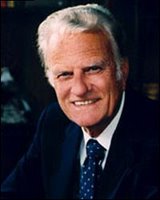
Spot the difference: Richard Dawkins and Billy Graham

With the publication of his latest book, Professor Richard Dawkins's anti-Christian in-your-face rants are back in the media. Ever since reading The Selfish Gene years ago, I have been a fan of the book, but I wish Dawkins would stick to popularising evolutionary biology and stay out of cultural politics.

People who argue that Dawkins's case against religion is weak or over-emotive miss the point. He isn't trying to bring light to a controversial topic; he clearly wants to fan the flames of the culture war. That, by now, is a more surefire way for him to gain social status and make money through book sales, lecture tours etc. than trying to enhance his reputation as a biologist. Why else would he make inflammatory comments such as "Catholicism is more harmful to children than sexual abuse".

Okay, I am being provocative. I don’t know that Dawkins wants to aggravate the culture war, but I am sceptical of his image as a rational analyser, whose only concern is the prevention of anti-intellectual indoctrination. His style is not suggestive of objective, dispassionate debate. Dawkins proves that evolutionism (like humanism, socialism, feminism, etc) can become a religion, in terms of the usual behavioural symptoms.

The hypocrisy of people like Dawkins is to expect us to agree that Christianity is the worst culprit in the area of shoving opinions down other people's throats. Perhaps it’s different in America, but here in Britain I feel much more assailed by the arrogance of egalitarianism, PC and all the other beliefs of the ‘liberal’ cultural elite, who assume they’re in the right and deserve to be promoted in educational institutions, than I do by Christianity. Christian leaders don’t even believe themselves any more in the doctrine (e.g. God shouldn’t be “he”; let’s abolish limbo) let alone try to sell it to others.

Dawkins’s arguments against the existence of God are interesting, but not exactly intellectually scintillating, and certainly not deserving of a proselytising mission. (“Dawkins is brilliant but arrogant”, it is often said. This stuff is supposed to be brilliant? Please.) His claim he is promoting rationalism is exaggerated. He would do better to condemn dumbing down on television, which has a far worse effect on the quality of thinking than religious belief.

If you're going to complain about children being indoctrinated with phoney values, why not start with the left-inspired ideology taught in schools these days under banners such as "citizenship" and "ethics"? The reason Dawkins picks on religion is simple (and it’s this which undermines his claim to be acting as the champion of enlightenment): it is an easy target because it’s already fashionable to kick it. Its intellectual power — certainly in formerly Protestant countries other than the US — is minimal. I have a bit more sympathy with Daniel Dennett plugging the same line in the US, as Christianity actually has some cultural influence over there.

According to a recent article in Wired, Dawkins is interested in "the politics of persuading people". Why should such politics be a good thing? It implies you know the right answer, which is not what science should be about. That includes the theory of evolution itself which, while it has a lot going for it, also has some serious problems and may not be the last word on the issue.

According to the same article, the leader of the "brights" movement, whose virtues Dawkins extols, says that moderates (e.g. agnostics) "give a power base to extremists". That sounds to me like taking sides in a culture war — and forcing others to do so — not like promoting rational analysis.