Showing posts with label Crime and law. Show all posts

17 January 2008

Lyrical terrorism and arbitrary powers

In response to my post on Samina Malik, a reader commented as follows.

Samina Malik was arrested with Sohail Qureshi, a man who has since admitted to being a terrorist. Malik was employed at an airport before her arrest, during which time she gave Sohail Qureshi information regarding airport security. Samina Malik is not being persecuted, Samina Malik is not "potty" nor is Samina Malik a "loon", Samina Malik is a terrorist actively aiding those who plan to commit mass murder according to the transcendant tenets of Islam. There is no equivalence between Lionheart and Samina Malik inspite of Tony Bennets comments, Samina Malik is an aggressor and her ilk, according to the transcendant tenets of Islam, have victimised Lionheart. Part of this victimisation includes a kind of "lawyer Jihad" for repressive legislation contrary to free speech (i.e. the "Religious Hatred Bill").

Malik may or may not have intended to commit terrorist acts herself. It wasn't obvious from her trial. The additional information about her given in the BBC item linked to above seems circumstantial at best.

"The jury found her not guilty of possessing articles for terrorist purposes. But they did convict of the lesser terror charge of collecting articles 'likely to be useful to a person committing or preparing an act of terrorism'."

I don't think we should have laws as vague as this. If we have to have a law relating to possession of literature at all, it should be very specific which items it's illegal to possess — like the Catholic Church's Index. Otherwise we are all dependent on the judgment of state officials as to whether something is "likely to be useful for preparing for terrorism".

I suppose the theory is: give the police and courts as much leeway as possible, so they can convict people who they 'really know' are guilty. Also known as arbitrary powers, as distinct from the rule of law. (See also here.)

Having written the above in response to the comment, I then came across an article (via Tim) which reminded me that the contemporary theme of increasing arbitrary powers is much wider than this. Indeed, it could be regarded as one of the key themes of mediocracy. "Society shall have the right to decide what it thinks best, unfettered by unnecessary restrictions on its behaviour designed purely to protect the individual."

In this latest instance of making the law more flexible and convenient for agents of the state, appeal judges are to stop taking into account that rules of procedure had been breached, if they are pretty sure that the accused is guilty.

Clause 42 of the criminal justice and immigration bill, which comes before the House of Lords next week, provides that appeal court judges must not rule that a conviction is unsafe if they think "there is no reasonable doubt about the appellant's guilt".

The government keeps chipping away at basic civil liberties and other protections. This process is not confined to the current incumbents but started with the last Conservative administration, though New Labour have adopted it with even greater enthusiasm than the Tories. A large state — i.e. one which takes up nearly half of total economic activity — will perhaps tend to move automatically in this direction. But the relentless dissemination of an ideology which (a) demands that 'we' arrange society in the way 'we' think best, and which (b) degrades the concept of the individual, clearly doesn't help.

20 September 2007

Institutionalised managerialism

Blogger "PC Copperfield" went public in Monday's Panorama programme — he is Stuart Davidson, formerly of Staffordshire Police. Sadly, this bobby with a powerful BS detector is leaving us for Canada, where apparently the mediocracy level in the police force has not yet advanced as far as it has in Britain. I hope we're not going to start getting a public sector common sense drain, to parallel our academic brain drain.

I like these two posts from his blog. The first one illustrates the 1+1=2 type of management course which many workers, particularly those from the public sector, are subjected to these days, and which helps to mop up much of their time.

28 November 2005
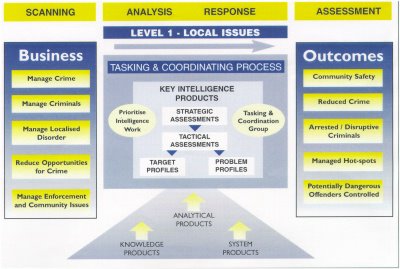
I'd like to think that the figure on the left was secret and that I have revealed something that is of vital importance in the war on crime. Sadly, it probably isn't.

As my CI, who incidentally has degrees in Chemistry and Oceanography and a PhD in Biology, points out: it's clearly nonsense.

The diagram is from Lancashire Police and purports to show the relationship between Problem Oriented Policing and the National Intelligence Model (NIM). For me though, most of the problems in policing today are encompassed in the diagram, which is almost beyond satire.

There are armies of people responsible for producing these diagrams and there are similar battalions responsible for the things shown in the diagram; things like "Tasking and Coordination", "Intelligence Work", "Strategic Assessments" and developing "Target Profiles" and "Problem Profiles". It always makes me snigger when these schemes are unveiled to shifts of two or three people: "Hang on, if you're doing community safety and I'm doing managed hotspots, who's doing the police work?"

The second post lucidly makes the core point of the Panorama programme: that police officers, like many other public sector workers, are now driven primarily by various government-set targets which supposedly maintain efficiency in the absence of market forces, but which mostly result in mere box-ticking behaviour.

26 April 2007
I’m all for measuring performance, after all, you might hope that having the police around would mean there was less crime rather than more, and we could measure that. You might also hope that where a crime has occurred, we would solve it.

The problem is that police forces are bureaucratic entities that depend upon “statistical significance” for their continued success. Those in charge don’t really depend upon the approval of local people for their salaries, they look instead to London and the Home Office. The Home Office judges police forces on one single statistic: how many people do we charge or caution.

The main problem with using the detection rate to measure performance is that it relies on people committing crimes first. The advantage for the bureaucrat is that it can be easily measured and a whole load of targets set. It all rather reminds me of the “body count” in the Vietnam War, when the US set great store by how many enemy they had killed, while all the time they were actually losing the war. Could it possibly be that even if we actually meet the all crime detection rate target, the public won’t feel the slightest bit safer?

Stuart also has a book out, Wasting Police Time. Well done for speaking out. Now could someone working in 'child protection' please do the honourable thing and follow his example, so we can get an inside view of that particular can of worms?

14 August 2007

Dumbing down among the judiciary?

Mediocracy likes to promote resentful belligerence towards other individuals as a form of self-assertion. Manners and self-restraint are examples of bourgeois fetishism and hence to be rejected.
(Mediocracy, p.35.)

What has happened to Not Saussure? This sober, reflective gentleman last blogged on Monday 18 June, when he wrote that he would be
back shortly ... probably on Tuesday or Wednesday; it is, people will be relieved to know, real life rather than Second Life that is demanding my attention at the moment, though personally I’d much rather the problems to which I have presently to attend were in a virtual rather than the real world.
I do hope he has not been kidnapped by virtual terrorists. We could do with his inside legal insight on the story of Hon. Mr. Justice Peter Smith, who seems a queer fish indeed, even by the standards of the British judiciary.

Last year, the learned judge became famous in the plagiarism suit against Da Vinci Code author Dan Brown, by inserting his own Code into the judgement — just for fun.
I hate crosswords, and do not do Sudoku as I do not have the patience
he explained in a statement. Very understandable; I'm sure life on the bench can be frightfully tedious at times.

Now it appears Sir Peter is in trouble again, for refusing to stand down as appointed judge on a case where there was a pretty clear conflict of interest, and for sounding stroppy about it to boot.

A partner in the law firm Addleshaw Goddard was recently up before the learned judge. This happened a few months after negotiations for Sir Peter to be hired by AG broke down, apparently because the firm thought his asking price of £750,000 pa was on the high side. When asked to step aside, Smith refused with some vigour and, when it was suggested his language had been intemperate, replied "It is about time you grew up. If you think that's intemperate, then you are on another planet from me."

I wonder whether what I call 'aggressification' — crude belligerence passed off as assertiveness — has started creeping into the legal profession ...

18 January 2007

Another 3 steps towards totalitarianism

1) Criminal trials without juries
See BBC News. Progress of Bill here.

2) Punishment without evidence of wrongdoing
Via Not Saussure. See also Telegraph.

3) Abolition of confidentiality
See Grauniad, also AC Grayling.

09 January 2007

'Justice centres' to provide killing service?

There's nothing like watching an execution to give people a taste for judicial murder.

The latest person to jump on the death penalty bandwagon is Dominic Lawson in the Independent. A discussion of his article can be found at Not Saussure. NS points out that, apart from the question of whether it's a good idea, there is an issue about whether it should be treated as a form of empowerment for the victims of crimes, as is sometimes suggested.
What would certainly seem unjust is a situation in which the penalty depended, even in part, on how forgiving or how vengeful were the grieving relatives. One of the main points about the law is that the penalties for breaking it should be known and consistent. Pace people who think that sentencing depends on what sort of mood the judge is in and how convincing a sob-story he’s given, there are pretty well-defined aggravating and mitigating features laid down by the Sentencing Guidelines Council and the Court of Appeal — and, for murder, by Parliament — that the judge has to stick to.

To throw that out of kilter when someone’s life is in the balance seems appallingly arbitrary, and it also seems quite dreadful to put someone in the position — as happened a few years ago, as I recall, when a young British woman was murdered while on holiday with her fiancĂ© in Florida — to put the survivor in a position where he has to plead for the lives of his partner’s killers on the grounds she was profoundly opposed to capital punishment.
There’s a worrying trend these days to make sentencing depend on the emotional reactions of various participants – victims, judges, the public. Last year it was decided to allow the families of murder victims to tell courts of their grief. In my opinion, this was another step on the road from a proper legal system towards ‘justice’ by tabloid editors and kangaroo courts.

The change in the law on double jeopardy a couple of years back was justified by the Attorney General saying that he would not be able to “look murder victim Julie Hogg’s mother in the eye” if the change didn't go through. This trend to personalise the law is not unique to Britain. I've read of US judges being criticised by fellow judges for failing to display sufficient emotions, or empathy with victims.

In a comment to his post, NS mentions that the crown court where he spends much of his time is being transferred to a new complex amalgamating the magistrates’ court, the police station and the Crown Prosecution Service offices. This complex will be referred to as a ‘Justice Centre’ - a development giving the legal staff some concerns.
This, they think, is a terrible idea since it’s promising something that they can’t deliver and don’t try to. Everyone involved in a case is going to have different ideas about what a ‘just outcome’ would be, and they can’t all be satisfied.
I think they’re right to be concerned. Names can matter, even if the change is merely part of a superficial rebranding exercise.

It is in my view a key symptom of mediocracy to relabel things in ways that both (a) dumb down and (b) have subtle propaganda objectives. An example is the name change of the Department of Trade and Industry in 2005 to “Department for Productivity”, which fortunately was quickly reversed after general derision from businesses.

The acolytes of Blairism seem to think that a name change is enough to bring about a brighter and better world. It’s the political equivalent of the fashion for makeover programmes on the telly. The implicit message is that appearance is more important than content.

Unfortunately, there is often something more sinister involved as well. In the case of ‘justice centres’, as NS suggests, it gives a false impression of what courts are there to do. Plus it reinforces the tendency to turn courts into something which will apply currently fashionable definitions of ‘fairness’, rather than the law as defined in statute.